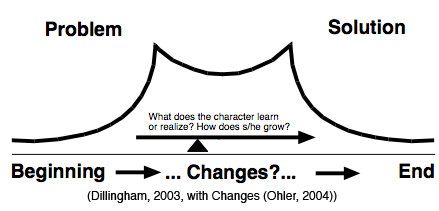
 Stories help us connect with others, sell a product, land a job, build empathy, motivate and persuade others. This simple graph can help us remember to build stories from challenges we face and the pivotal events that caused us to grow or learn.
 Wednesday, February 27, 2013
Picture helps us focus our storytelling
Stories help us connect with others, sell a product, land a job, build empathy, motivate and persuade others. This simple graph can help us remember to build stories from challenges we face and the pivotal events that caused us to grow or learn. 

Thursday, November 1, 2012
Simple model to create stories for interviews, networking and other career events.
When I teach storytelling for job seekers or those seeking career advancement I offer the STAR model. Frame your story around a Situation, Task needing completion, Action you took (that saved the day), and the (stellar) Result. This model can help us create a concise yet compelling story that builds empathy and connection with others.
Thursday, October 18, 2012
Need to Motivate Your Team (or Yourself?)
Spaces are still available for this class at Waubonsee College!
This is one of my favorite DDI courses. Previous participants have found the ideas to be fresh, innovative, and practical. Class size will be small, you or your staff will have plenty of time to explore your specific needs.
Motivating Others 10/24, 8:00am-12:00pm
In
today's fast-paced, global business environment, external forces are
compelling companies to change their business practices to stay
competitive. In this course, you will learn how to proactively create an
environment in which people are highly motivated to perform. You will
explore the three factors that affect the motivation of employees:
focused work, interpersonal support, and individual value.
As
a result of this course, you will be able to determine which factors
are low in your individual workplace and emerge with both a plan of
specific actions and the skills needed to build group and individual
motivation. Fee includes: materials.
To register visit this page:
Sunday, October 14, 2012
Emotional Intelligence at the Movies
We just watched "Bernie" with Jack Black. While my hubby and I wouldn't call it a "great movie," I'd recommend it from an EI perspective. It is especially interesting because it is based on a true story of a man who was able to create happiness in any kind of circumstance. It also contained an example of a "emotional hijack."

Sunday, September 30, 2012
How do we gain "political" intelligence?
I read this question in a recent Linkedin group. It reminded me of a study in a great EI book-- "Opening Up: The Healing Power of Expressing Emotions" by James Pennebaker. The study indicated that when we deny or repress our emotions, our ability to conduct complex analysis can be diminished and we can be conned by salespeople, politicians, etc. One explanation is that as energy is expended in one part of the brain (working at repressing the disturbing emotion), other brain functions may not work as well. This makes sense to me.
Friday, August 17, 2012
Courage at work
Courage is being scared to death, but saddling up anyway. - John Wayne
Think
about problems in a workplace. If we're honest, don't many of our
struggles with teams and other coworkers stem from a lack of courage?
We're afraid to give accurate feedback or make a frank complaint.
Instead we might gossip to others or avoid a necessary conversation.
Performance reviews aren't the only time to have a courageous
conversation. Every time we opt out of sharing a vital truth, we lose
the benefits of courage in the workplace. We lose trust, authenticity,
and the aliveness that comes from living honestly.
How do we develop such courage?
Leslie E. Sekerka (interviewed by Kristin Bjorn) gives some helpful tips in Character First Magazine. She suggests practicing several key skills to help develop moral courage. They are also key EI skills.
Courageous people employ:
- Emotional signaling: People with professional moral courage do not ignore, repress, or sublimate negative feelings. They use this affective information as a signal to proceed with caution and care.
- Reflective pause: During this break individuals examine possible avenues for right action, often weighing the pros and cons of the circumstances, while also thinking about potential implications.
- Self-regulation: Managing one's feelings and desires is vital, demonstrating an ability to apply restraint coupled with an ability to move forward.
To read the entire article visit this link:
Thursday, August 16, 2012
We're not alone.
Just met with another client and am always struck by how universal our problems are. We think we're unique and suffering alone. We're mostly struggling with the same issues. That fact always helps my clients feel a little better. That, and the fact that behavior can change with insight and effort.
Friday, August 3, 2012
Today's tweet
Improve your public #speaking? Small class! 8/8, 9-5 #Waubonsee College, Sugar Grove, IL. 1 day lifechanger. Fun too. http://twt.mx/RumH
Wednesday, July 25, 2012
What's your conflict style?
How
do you handle conflict? Typically, where do you find yourself on the
graph below? While there are times when avoiding, accommodating,
competing, and compromising are appropriate reactions-- for best
long-term results, collaborating is most effective. This style of
resolving conflict requires a mindset of curiosity, creativity, and
comfort with uncertainty. Collaborating may take longer than compromise
but its win/win solutions feel great. They build morale and can
further increase motivation and
innovation.

Friday, June 29, 2012
Join us this Sunday at the Life Force Arts Center! More info.
Embodied
Myth: Exploring “The Three Languages”
Embodied Myth is a depth group process that uses the great
body of world literature to gain a better understanding of ourselves and our
connection to the world around us. Through Embodied
Myth, we gain a greater understanding of what is going on under the surface
of life, using the myth as a tool, a guide, and a safe structure. We reconnect
with unrecognized parts of ourselves, the archetypal forces tugging inside and
outside us. We also encounter the healing wisdom hidden in myths and
fairytales. The archetypal themes in these old stories hold true across
cultures and time.
The German fairy tale The
Three Languages explores the hero’s journey, our connection to animals, and
our own instincts. Using storytelling, meditation, role-playing, and
discussion, we enter the story on a deep and personal level, and at the same
time realize our connection to another time and place. Come join us in a
storytelling circle. We’ll explore our
own mythic journeys and meet archetypes within the story and within
ourselves. No acting experience
necessary, participants can choose to act or be part of the audience.
Monday, April 2, 2012

Wednesday, December 21, 2011
Ben Franklin and New Year's Resolutions
Just found this list of virtues developed by Ben Franklin. A good reminder for living a healthier, more balanced life. Could be useful if you're looking for a New Year's resolution.
Benjamin Franklin’s Virtues and Precepts
Benjamin Franklin’s Virtues and Precepts
· TEMPERANCE -Eat not to Dullness, Drink not to Elevation
· SILENCE - Speak not but what way benefit others or your self. Avoid trifling conversation.
· ORDER -Let all your Things have their Places. Let each Part of your Business have its Time.
· RESOLUTION - Resolve to perform what you ought. Perform without fail what you resolve.
· FRUGALITY - Make no expense but to do good to others or yourself: i.e. Waste nothing.
· INDUSTRY - Lose no Time – Be always employed in something useful. – cut off all unnecessary Actions.
· SINCERITY - Use no hurtful Deceit. Think innocently and justly;and, if you speak; speak accordingly.
· JUSTICE - Wrong none, by doing Injuries or omitting the Benefits that are your Duty.
· MODERATION - Avoid Extremes. Forbear resenting Injuries so much as you think they deserve.
· CLEANLINESS - Tolerate no Uncleanness in Body, Clothes or Habitation.
· TRANQUILITY - Be not disturbed at Trifles, or at Accidents common or unavoidable.
Wednesday, November 30, 2011
Quote to Live By
Your time is limited, so don't waste it living someone else's life. Don't be trapped by dogma - which is living with the results of other people's thinking. Don't let the noise of other's opinions drown out your own inner voice. And most important, have the courage to follow your heart and intuition. They somehow already know what you truly want to become. Everything else is secondary.
---Steve Jobs
---Steve Jobs
Wednesday, September 21, 2011
Quote from my friends at Six Seconds
"When we are no longer able to change a situation, we are challenged to change ourselves."
- Viktor Frankl
- Viktor Frankl
Friday, September 16, 2011
Are you missing some important data today?
According to Peter Salovey (Yale University), Emotions are "real-time feedback signals." What are your emotions telling you today?
Thursday, September 15, 2011
An important reminder. Anger is not the problem.
Angry feelings contain information. How we use this information (our behavior) is key. Our anger can motivate us positively—to try harder. Or negatively, to give up or lash out. Repressing anger is not the same as managing anger. Repression backfires. Managing anger allows us to communicate effectively with others and obtain useful information (and motivation) for ourselves.
Wednesday, September 14, 2011
"Birth of an Idea" Fun!!!
The Creative Process Takes Time. Are you giving time for your own gestation of new ideas?
Untitled from Joe Russell on Vimeo.
Untitled from Joe Russell on Vimeo.
Thursday, August 4, 2011
Is it possible to teach Emotional Intelligence (and why should we bother)?
I’ll confess: even though I know the value of EI (proven in research and my own experience), sometimes the subject seems too hard to teach. Most of us have been taught to avoid and repress our emotions. The simple question: What are you feeling right now?” is often met with blank stares or vague generalities: “I’m good.”
Since our emotions are often confusing or embarrassing, our reluctance to explore them makes sense. And even if we can figure out what we’re feeling, what difference does it make?
One reason to explore our emotions is that they are the only way to glimpse our “internal wiring.” Each of us “run” on a “program” of unconscious thoughts, beliefs, fears, biases, and desires. Our emotions are a window into these deeper parts of ourselves. Even if our emotions don’t reflect “reality” they do reflect our own perceptions. Learning to understand our inner world is the first step toward understanding how we “tick.” Then we can learn when to trust or distrust our instincts. We can develop our own unique intuition, a moment by moment GPS system that can guide us in the hundreds of decisions we make every day.
Ignoring our emotions is like refusing to read the directions for a powerful new gadget. Without this technical information, we’ll probably overlook some really cool device applications. Likewise, without a deeper knowledge of our own emotional patterns, we can misread others, make poor choices, and get stuck in some miserable situations.
It is also impossible to develop empathy (the WD40 of relationships) without emotional awareness. How can I understand your fear or anger if I’m unaware of my own?
Examining our emotions isn't easy but, like any skill, we will improve with practice. The rewards for this self-knowledge are great.
Since our emotions are often confusing or embarrassing, our reluctance to explore them makes sense. And even if we can figure out what we’re feeling, what difference does it make?
One reason to explore our emotions is that they are the only way to glimpse our “internal wiring.” Each of us “run” on a “program” of unconscious thoughts, beliefs, fears, biases, and desires. Our emotions are a window into these deeper parts of ourselves. Even if our emotions don’t reflect “reality” they do reflect our own perceptions. Learning to understand our inner world is the first step toward understanding how we “tick.” Then we can learn when to trust or distrust our instincts. We can develop our own unique intuition, a moment by moment GPS system that can guide us in the hundreds of decisions we make every day.
Ignoring our emotions is like refusing to read the directions for a powerful new gadget. Without this technical information, we’ll probably overlook some really cool device applications. Likewise, without a deeper knowledge of our own emotional patterns, we can misread others, make poor choices, and get stuck in some miserable situations.
It is also impossible to develop empathy (the WD40 of relationships) without emotional awareness. How can I understand your fear or anger if I’m unaware of my own?
Examining our emotions isn't easy but, like any skill, we will improve with practice. The rewards for this self-knowledge are great.
Wednesday, August 3, 2011
EI Thought for the Day
"Knowing others is intelligence; knowing yourself is true wisdom. Mastering others is strength; mastering yourself is true power.
Tao Te Ching
Tao Te Ching
Tuesday, July 19, 2011
How feelings affect the bottom line.
My friend, Jill, is getting a new website. Her designer, Doug, is an exuberant, fun professional. Still, sporadically he will send Jill an angry email complaining about her requests. The emails are respectful and polite but we can feel his anger. Jill is always surprised by these angry outbursts. Why is Doug angry? Jill would be happy to pay more if the job required it.
After a flare-up, Doug is extra helpful and often apologizes. But the damage has been done. Jill won’t be using Doug again and she won’t refer him to others. His repressed anger makes her uncomfortable. If he would simply say to her, “I’m afraid that the scope of our work is expanding," Jill could hear this. But Doug remains oblivious to his own feelings and their effect on his business.
© 2011 Laura Lewis-Barr all rights reserved
After a flare-up, Doug is extra helpful and often apologizes. But the damage has been done. Jill won’t be using Doug again and she won’t refer him to others. His repressed anger makes her uncomfortable. If he would simply say to her, “I’m afraid that the scope of our work is expanding," Jill could hear this. But Doug remains oblivious to his own feelings and their effect on his business.
© 2011 Laura Lewis-Barr all rights reserved
Subscribe to:
Posts (Atom)