Managing the normal anxiety present in public speaking means using our nervousness to create peak performance, instead of derailing the presentation. Even professional speakers have nervousness at times. A commitment to excellence also means that we might experience stress when speaking. Join us next month to learn methods to channel our nerves into dynamic presentations.
© 2019 Laura Lewis-Barr all rights reserved
Exploring my training passions--emotional intelligence and dynamic presentations.
Sunday, October 20, 2019
Friday, October 18, 2019
Storytelling builds trust at work
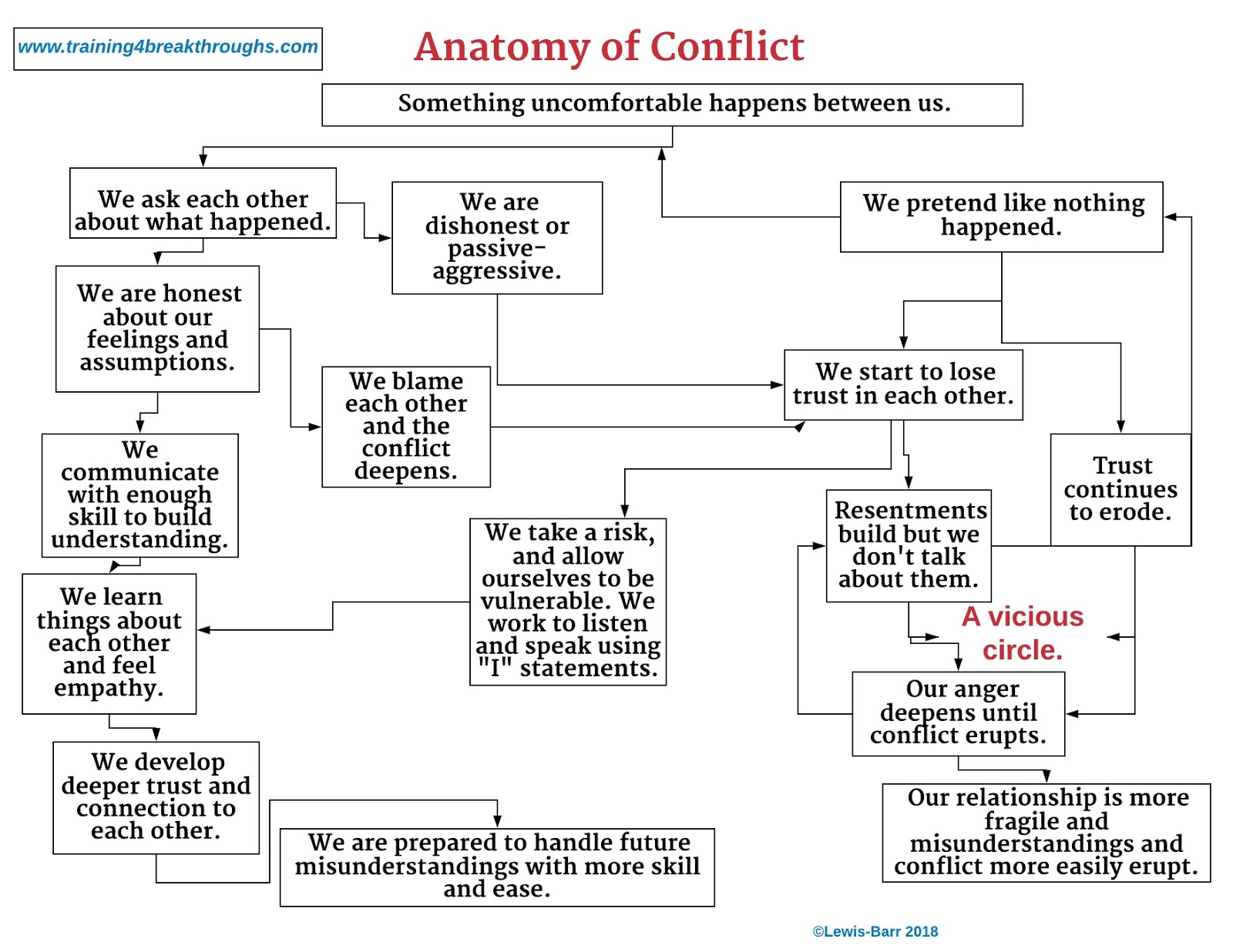
Learning to tell our own stories offers many benefits. I love flowcharts and made this one to reflect on conflicts. I've circled where business length stories are helpful. Well told stories can enhance trust and reduce conflict.
© 2019 Laura Lewis-Barr all rights reserved
Wednesday, October 16, 2019
Does Your Audience Look Like This When You/re Speaking?
Tuesday, October 15, 2019
Communication loop and stories
Communication is hard under the best of circumstances. Our different life experiences determine how we "encode" and "decode" messages. Stories are a great equalizer. They help a listener understand our experience. Stories help listeners and speakers enter each other's mind.
Sunday, October 13, 2019
Stories are Powerful.
© 2019 Laura Lewis-Barr all rights reserved
Thursday, September 19, 2019
Stories at work

“I’m scared” said Piglet.
“A story will help” said Pooh.
“How?”
“Oh. Don’t you know? Stories make your heart grow.”
(Milne, 1979)
Tuesday, April 2, 2019
More from the work of Brene Brown -- What kind of Leader Are You?
Driving
Perfectionism and
Fostering Fear of Failure
Vs.
Modeling
and Encouraging
Healthy Striving, Empathy,
and Self-Compassion
Healthy Striving, Empathy,
and Self-Compassion
Thursday, March 28, 2019
Monday, March 25, 2019
Friday, March 22, 2019
Wednesday, October 24, 2018
What is Emotional Intelligence?
I’ve been exploring the field
of emotional intelligence (EI) for a while now but still ask myself fundamental
questions such as—what do I mean by Emotional Intelligence? I know some
standard answers. I can spout out skills and competencies to be taught or
assessed. Still, deeper questions linger.
My husband, Rick, is struggling with an angry colleague at work. “Jim” recently raised his voice at Rick, saying, “I’ll get to it!” While the words themselves were not abusive,
Jim’s angry delivery upset Rick. My husband walked away, enraged and confused. As we talked about the episode, I scoured my mind for helpful exercises. Rick could examine his thoughts and see how they led him into a habitual pattern of withdrawal from confrontations. He could look at his own “reaction cycle” and practice other responses to the often-unpredictable Jim.
We both agreed that Rick needed to stand up for himself more. Ideally, he could strongly but calmly let Jim know that his behavior was unacceptable. But, knowing Jim, and knowing the often brutal company culture, would this work or even be the best option?
Rick could fight fire with fire. He could throw back strong language and a fierce delivery. Would this be a more emotionally intelligent action under the circumstances? There are no clear-cut answers in this work (one reason I love it so much). Brutal self-honesty is necessary to help discern what is ethically responsible and emotionally intelligent. It is the work of a lifetime.
My husband, Rick, is struggling with an angry colleague at work. “Jim” recently raised his voice at Rick, saying, “I’ll get to it!” While the words themselves were not abusive,
Jim’s angry delivery upset Rick. My husband walked away, enraged and confused. As we talked about the episode, I scoured my mind for helpful exercises. Rick could examine his thoughts and see how they led him into a habitual pattern of withdrawal from confrontations. He could look at his own “reaction cycle” and practice other responses to the often-unpredictable Jim.
We both agreed that Rick needed to stand up for himself more. Ideally, he could strongly but calmly let Jim know that his behavior was unacceptable. But, knowing Jim, and knowing the often brutal company culture, would this work or even be the best option?
Rick could fight fire with fire. He could throw back strong language and a fierce delivery. Would this be a more emotionally intelligent action under the circumstances? There are no clear-cut answers in this work (one reason I love it so much). Brutal self-honesty is necessary to help discern what is ethically responsible and emotionally intelligent. It is the work of a lifetime.
The good news is that we can become more "emotionally intelligent" over time. Future posts will give ideas on how.
© 2018 Laura Lewis-Barr all rights reserved
Wednesday, September 5, 2018
slideshow of team building and interactive training
Sorry to see that some camera shots aren't clear. That's because I'm rarely standing still long enough during a team building or training event to take a great photo. At least that's my excuse! But this can give an idea of the types of team building and training events I can offer with partners like the Leaders Institute and other great companies and colleges.
© 2018 Laura Lewis-Barr all rights reserved
Friday, July 27, 2018
Haiku at work
I submitted the report by noon
per your commands --
Communication is complicated! Nonverbals override verbal messages every time.
© 2018 Laura Lewis-Barr all rights reserved
Thursday, July 26, 2018
Hidden and Seen -- Shakespeare at work: lessons from the bard on emotional intelligence and communication.
2. Hidden and Seen
HAMLET: (to his
mother the Queen) I shall in all my best obey you madam.
KING: Why, ‘tis a loving
and a fair reply.
Hamlet Act 1 scene 2
Hamlet is enraged with his mother, the Queen. But neither his uncle, the new king, or his
mother acknowledge his curt and petulant replies. They both act as if Hamlet is content with
the new realities -- a new king and royal marriage. Are they clueless, or do they think their
pretense will persuade Hamlet to accept the rapid changes?
I’ve witnessed similar denial at the workplace. Employees pay lip service to the new
corporate directives but even a visitor like me can see their disdain. If we ignore the tone of voice or facial
expressions in a conversation we will likely miss the real message.
HAMLET: But I have that within which passes show;
Hamlet Act 1 scene 2
Here Hamlet tells his mother that his grief is beyond what
she can see. His entire speech is a warning
against judging outward appearances that can be faked. Hamlet understands the difference between his
inner truth and what he shows the world. To know our rage, fear, or sadness is
one aspect of emotional intelligence. To
know how and when to express our truth is another part of EI.
from the upcoming book
Shakespeare at work: lessons from the bard on emotional
intelligence and communication.
© Lewis-Barr All
rights reserved.
Wednesday, July 25, 2018
Empathy, discovering another person's perspective.
When we listen well and slow down, discovering another person's deeper truth can feel like a sudden shock. Just like seeing the actual color of these camels. (Not black).
© 2018 Laura Lewis-Barr all rights reserved
Shakespeare at work: lessons from the bard on emotional intelligence and communication.
1. Thinking of Ghosts
HORATIO (speaking to the Ghost): What art thou that usurp’st this time of
night?
Hamlet Act 1 scene 1
As a corporate trainer, I visit many different companies and
often sense “ghosts” in the room. These
may be the lingering effects of former bosses or even policies that bolster or
torment my participants.
Even more influential are the ghosts of previous, unresolved
conflicts within the organization. Morale
and learning are both affected by these ghosts that linger in the minds of my participants. As each grapples with these ghosts, they are not
fully present to our workshop or each other.
MARCELLUS: Something
is rotten in the state of Denmark.
Hamlet Act 1 scene 4
© 2018 Laura Lewis-Barr all rights reserved
Tuesday, July 24, 2018
EI haiku
My hardworking brain
creates your reply
even before you speak.
© 2009 Laura Lewis-Barr all rights reserved
Monday, July 23, 2018
Haiku -- EI = safety
Boss scowls across warehouse.
Electric cords wait like a snake.
© 2018 Laura Lewis-Barr all rights reserved
Friday, July 20, 2018
Haiku -- inviting us to take a breath and reflect.
Watching for the tiger
I don’t hear a word you say.
I’m ready to pounce.
The emotional brain is 80K times
faster than the part of us that creates conversation.
© 2018 Laura Lewis-Barr all rights reserved

Thursday, July 19, 2018
Subscribe to:
Posts (Atom)